
Helix Adaptive Strategy
Structured execution.
Star-rated signals.
Capital-first by design.
A TradingView strategy built to grade signal quality, manage exits, and protect capital through a rule-based execution workflow.
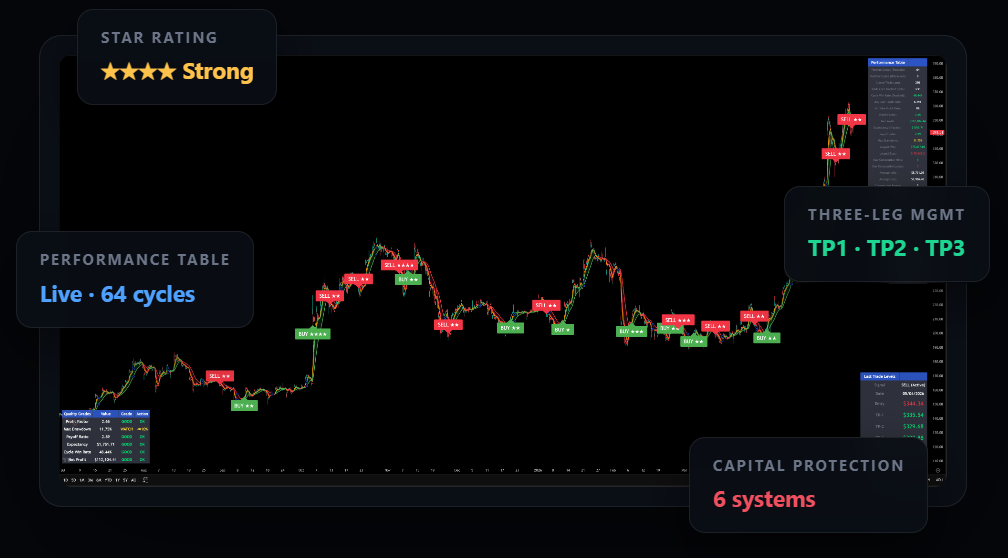
The Helix Adaptive Strategy combines Gaussian Ribbon trend detection, star-rated signals, Delta Engine confirmation, choppiness filtering, three -leg position management, and six layered safety systems designed for traders who want fewer, higher-quality setups managed with structure.
WHY THE STRATEGY EXISTS
Signals are easy. Execution is the hard part.
Most strategies fire labels. Few of them tell you when a setup is actually high quality, how to manage the position once you’re in, or when to step aside completely.
Most strategies over-signal
Too many systems fire signals without enough structure, context, or quality control. Frequency replaces conviction, and the trader is left to filter the noise manually.
Exits become emotional
Traders often know where to enter but struggle to manage stops, profit targets, runners, and risk after the trade begins. The plan starts to drift the moment the position opens.
Rules before reaction
Helix Adaptive Strategy structures entries, exits, position legs, quality grading, and capital protection into one TradingView strategy workflow — designed to make the next decision a rule, not a reaction.
HOW IT WORKS
Seven steps.
One strategy pipeline.
Every signal flows through the same pipeline - from trend detection through capital protection. Confluence is built in, not improvised.
Detect Trend
Gaussian Ribbon determines directional bias.
Confirm Timing
Ribbon cross plus one-bar confirmation.
Filter Momentum
RSI window and Delta Engine confirm direction.
Block Poor Conditions
Choppiness Index helps avoid sideways markets.
Grade the Signal
Star Rating converts setup quality into 0–5 stars.
Manage the Position
Three-leg trade management for TP1, TP2, TP3.
Protect Capital
Regime flip, ATR breaker, daily loss, drawdown halt.
STAR-RATED SIGNAL QUALITY
Setup quality - scored before the signal reaches the chart.
The Star Rating system grades every potential setup from 0 to 5 stars. Quality is part of the signal itself.
A quality gate, not a counter.
Each signal is scored on ADX with directional confirmation, volume Z-score, ribbon quality, volatility expansion, and breakout confirmation. The composite raw score (0–9) maps onto the 0–5 star band you see on the chart.
Delta is intentionally excluded from the Star Rating to avoid double-counting momentum. Instead, the Delta Engine acts as a separate hard filter - a binary momentum gate that the signal must pass before the star score even applies.
Traders can set a minimum star requirement to suppress lower-quality setups, and optional adaptive position sizing can scale exposure to the rating less on marginal reads, more on the cleanest ones.
Score components and weights are visible inside the configuration tables.
The minimum star threshold is configurable per trading profile and risk level.
Adaptive sizing is optional - traders can run a fixed exposure model if preferred.
THREE-LEG POSITION MANAGEMENT
One signal. Three exits. Engineered structure.
Each entry is broken into three legs with their own targets and trail logic. Designed to take partial profit, lock breakeven, and let a runner work without abandoning the plan.
TP1
The first leg closes at TP1 and shifts the remaining position's stop to breakeven — designed to neutralize directional risk on the rest of the trade.
TP2
The second leg exits at TP2 and the remaining position begins trailing — built to protect captured profit while leaving room for continuation.
TP3 Runner
The runner targets TP3, closes at the trailed level, or stops at structure — designed for letting strong moves work without overstaying them.
Targets can be Adaptive ATR, Key Levels, or Volatility Bands.
Stops can be Key Levels, Volatility Bands, or Auto Stop. After TP1, the stop moves to breakeven. After TP2, trailing mode activates. The TP3 runner uses trailing stop logic.
CAPITAL PROTECTION
Six capital protection systems built into the workflow.
Risk control is treated as part of the strategy, not an afterthought. Each system fires under specific conditions, by priority, with rules the trader can review.
Regime Flip Exit
Exits before TP1 if the broader trend invalidates — designed to protect the position when the regime that supported the entry changes.
ATR Circuit Breaker
Forces an exit during extreme adverse movement — designed to step aside on volatile, gap-style adverse moves rather than trade through them.
Daily Loss Limit
Closes the open position and halts trading for the rest of the session if the configured daily loss limit is reached.
Maximum Drawdown Breaker
Forces an exit and halts trading once realized drawdown crosses the configured threshold — designed to protect capital before discretion can override.
Cooldown System
Prevents immediate re-entry after losses, with optional extended pause after consecutive loss streaks — designed to break revenge-trading patterns.
End-of-Day Exit
Closes positions before session end in Day Trader mode — designed to remove overnight risk from intraday workflows.
Priority order. Forced exits follow a strict priority model: Max Drawdown → ATR Circuit Breaker → Regime Flip → End-of-Day Exit.
Daily Loss Limit and the Cooldown System operate alongside this priority chain to govern what happens after an exit.
QUICK SETUP
Powerful, but approachable.
Choose a Trading Profile and a Risk Level - or let Auto Mode pick the profile based on your chart timeframe.
Scalper
- 1 minute to 15 minute charts
- Faster signal cadence
- Shorter holds
Day Trader
- 5 minute to 60 minute charts
- Balanced intraday baseline
- Default profile
Swing Trader
- 4 hour to daily charts
- Slower signal cadence
- Multi-day context
Custom
- Full manual control
- Override any baseline
- Build your own profile
Conservative
Stricter filters, fewer trades, longer cooldowns, tighter risk — designed for traders who want a higher quality bar before entries.
Balanced
Balanced baseline. The default risk level for most traders — reasonable filtering and standard exposure.
Aggressive
Looser filters, more trades, shorter cooldowns, wider exposure — designed for traders who accept more frequency in exchange for a less restrictive entry gate.
The Strategy can auto-select your profile from your chart's timeframe: 5 minutes or less → Scalper · 6 to 60 minutes → Day Trader · 4 hour and above → Swing Trader.
LIVE ON-CHART TABLES
Five tables. Total visibility.
Every active config, every last-trade level, every performance metric, every quality grade, every execution detail - surfaced on your TradingView chart in real time.
Performance Table

Tracks position cycles, closed trade legs, cycle win rate, profit factor, net profit, expectancy, payoff ratio, drawdown, largest win and loss, loss streaks, cooldown bars remaining, last exit reason, daily loss, and adaptive sizing state.
Quality Grades

Summarizes key backtest metrics — Profit Factor, Max Drawdown, Payoff Ratio, Expectancy, Cycle Win Rate, and Net Profit — with GOOD or WATCH labels and a recommended action column.
Last Trade Levels

Shows the active signal direction, date, entry, TP1, TP2, TP3, stop loss, and bars flat since exit — so the most recent trade plan is visible at a glance.
Execution Quality

Reports intended exposure, actual exposure, average fill deviation, and the current position's star rating — designed to make execution quality visible alongside the trade itself.
Active Config Table
Displays the strategy's currently active configuration directly on the chart — profile, risk level, preset state, minimum star threshold, exposure, cooldown bars remaining, and Delta Engine state. So the active rules are never invisible.
Signals are graded by quality before they print.
FULL WORKFLOW EXAMPLE
Everything working together.
All on one chart.
Star-rated BUY/SELL labels, live tables, performance visibility, last trade levels, and strategy configuration all displayed together inside TradingView.
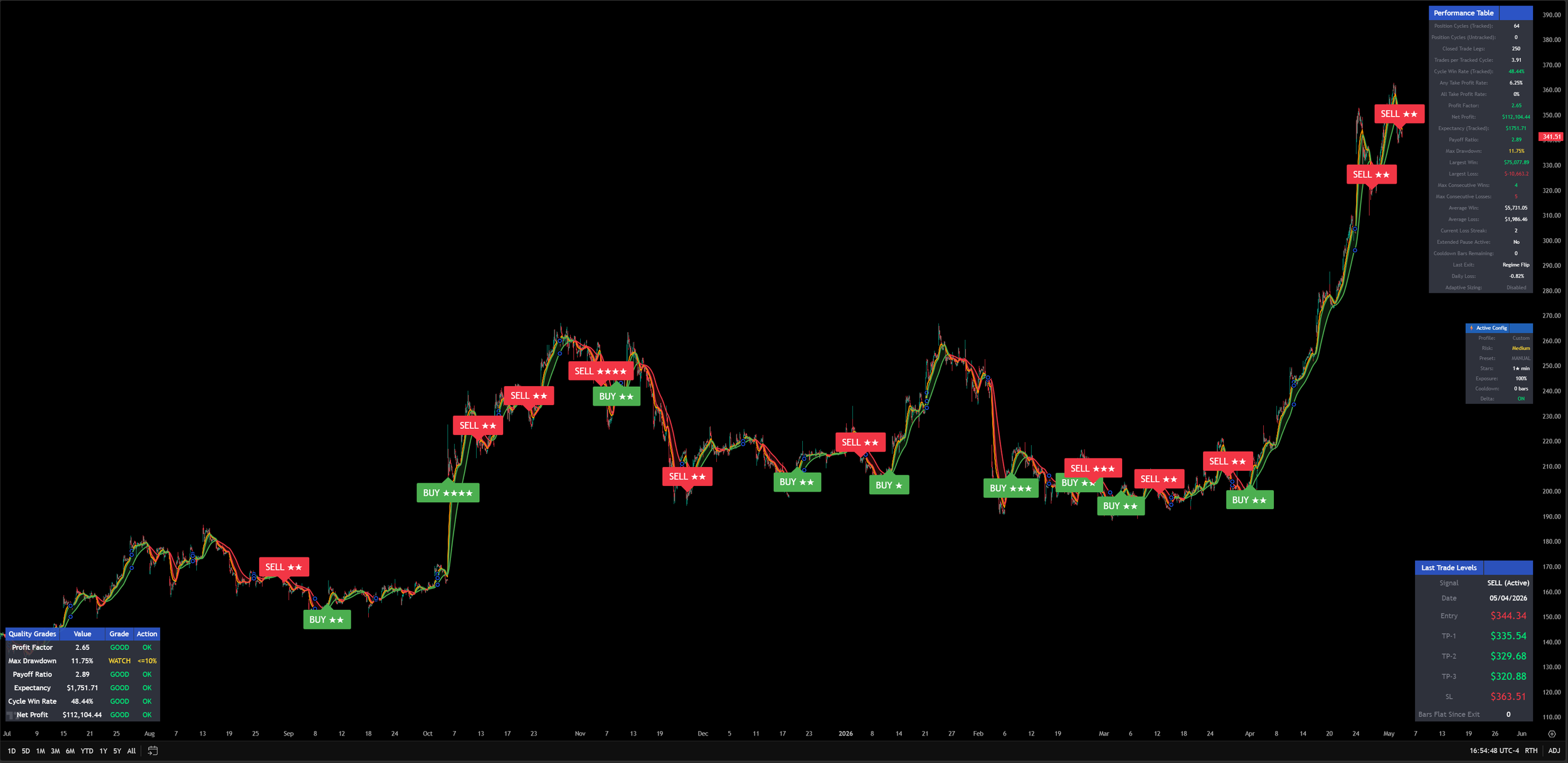
Star-rated BUY/SELL labels, live tables, performance visibility, last trade levels, and strategy configuration all working directly on the TradingView chart.
Trade levels are plotted visually for every active position.
Performance and quality metrics stay visible at all times.
Active configuration is always easy to verify.
Behavior can be reviewed before risking live capital.
WHAT MAKES IT DIFFERENT
Four things basic strategies don’t do.
Helix Adaptive Strategy was built around the parts of the standard signal-strategy workflow that produce the most pain.
Quality gate before entry
The Strategy filters for setup quality — star score, momentum, choppiness, regime — before printing trade signals.
Execution after entry
The Strategy actively manages TP1, TP2, TP3, breakeven, and trailing logic. Execution doesn't end at the entry label.
Risk controls are built in
Capital protection is part of the system, not an afterthought — six layered safety mechanisms with a defined priority order.
Backtesting with structure
The Strategy provides a repeatable, on-chart way to evaluate performance and refine settings — quality grades and execution metrics included.
WHO IT’S FOR
Built around four trader profiles.
Helix Adaptive Strategy fits multiple trader types - from those who want a clean baseline through those building a fully tuned, journaled research framework.
Foundational Trader
Wants clear BUY/SELL context and visible trade levels without guessing where to take profit or place stops.
Strategic Trader
Wants a structured plan for entries, targets, stops, and quality review — the same checklist, every trade.
Advanced Trader
Wants filters, presets, risk controls, performance tables, and configurable execution logic that fit their personal trading process.
Expert Trader
Wants a backtestable, customizable strategy framework for repeatable research, tuning, and forward testing.
HOW IT PAIRS WITH THE INDICATOR
The Indicator reads the market.
The Strategy structures the execution.
HelixStrat access is one subscription for both scripts together. Context on one side, structure on the other, on the same chart.
Helix MTF Indicator
Provides real-time market context — multi-timeframe bias, key levels, scoring, decision support, and dashboards on the chart.
- Multi-Timeframe Bias Table from 1m to Quarterly
- Price Point Live Dashboard with key levels and scores
- Trend Strength Score and Trade Probability Score
- Decision Engine with six clear states
- Volatility State and Relative Strength readings
Helix Adaptive Strategy
Provides backtestable execution logic — star-rated signals, three-leg trade management, and capital protection on the chart.
- Star-rated BUY / SELL signals (0 to 5 stars)
- Three-leg position management with breakeven and trail
- Six layered capital protection systems
- Live Performance, Quality Grades, and Last Trade tables
- Quick Setup profiles for Scalper, Day Trader, Swing Trader